


A lesson on the importance of listening I will never forget
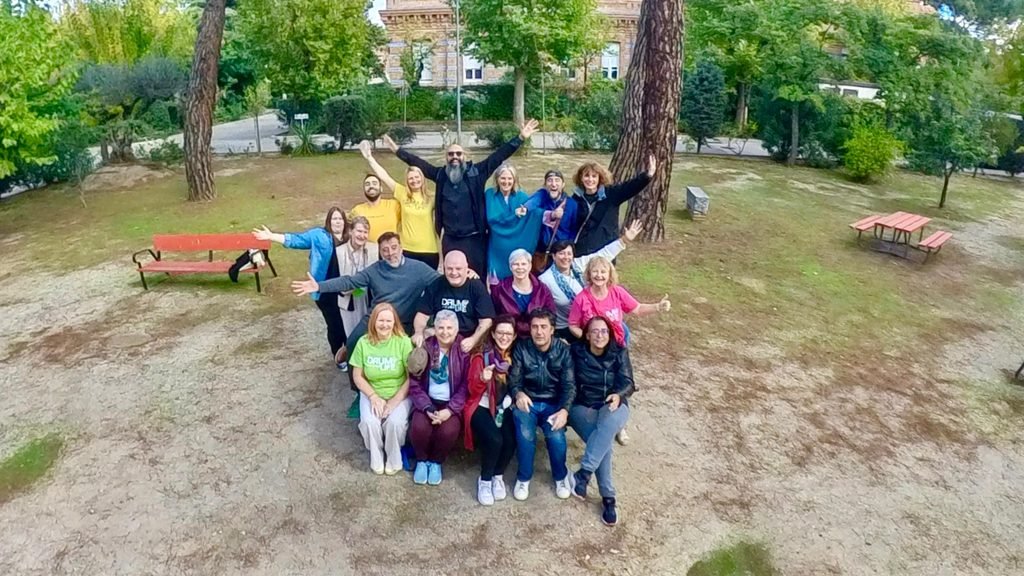
In October 2024 I was in Madrid to participate as a trainer in the European Conference of Drum Circle Facilitators, organized by ASFAPER, the Spanish association that brings together professionals in musical and rhythmic facilitation.
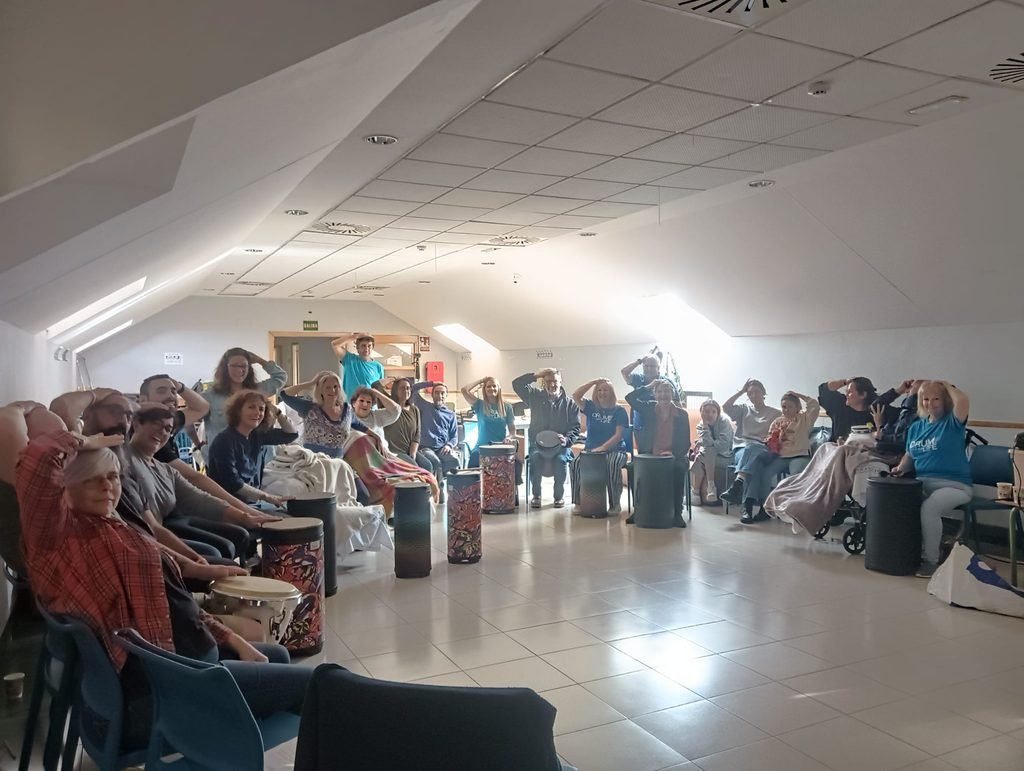
The conference took place at Fundación San José, a facility that serves people with disabilities and complex care needs. During those days a music therapist working at the facility invited me to participate in a musical session with some patients in a minimally conscious state.
I already had training in music therapy and several years of experience in musical facilitation, but I had never worked with people in those conditions. I accepted with curiosity, convinced that the skills I had acquired up to that point would help me understand how to intervene.
We entered two large adjoining rooms, where about sixty patients were housed. The music therapist knew each of them, knew which musical stimuli she habitually used, and had identified, for each one, a note or piece that seemed to elicit a response.
She accompanied me to the bedside of a young man and explained that, in his case, the note E and low frequencies were the sound stimuli to which he seemed most sensitive.
I took the guitar and began to improvise, also using my voice and trying to build a musical environment that might encourage a reaction from him. I alternated melodic phrases, low sounds, small rhythmic variations, observing his body carefully in the hope of catching some signal.
Nothing happened.
I continued for a while, trying to modify what I was doing, until the music therapist stopped me.
“Make space, listen, you’re not giving him a chance to express himself.”
She was right, and it struck me because, at least in theory, I knew very well how important it was to listen. It was one of the principles on which much of my work was based and which I tried to convey daily to the people I worked with.
Yet, in that moment, I was so focused on what I was playing and on the possibility of getting a response that I hadn’t realized how little space I was leaving for the young man.
Learning to make space
I began to play less, leaving longer pauses between one musical phrase and the next. I tried to observe without anticipating anything, waiting for him, possibly, to suggest how to continue.
After a few moments I noticed very small movements starting from his feet and slowly spreading along his body, until his chest rose and a sound came from his mouth, a kind of rasp.
I was surprised, but I continued to follow the music therapist’s guidance. I would play a short phrase, stop and wait. The young man would produce a sound and I would resume, trying to integrate it into my improvisation.
This alternation began to repeat itself and, while unable to attribute a precise meaning to those responses, I had the feeling that we were building a form of musical dialogue.
At a certain point two other young men, in nearby beds, also began to produce sounds. I found myself improvising while trying to listen to and welcome what was coming from each of them.
I don’t know how long it lasted, but I remember very well the feeling I had. I had entered that room thinking I knew what to do, convinced that my task was to use music to stimulate a response, and I found myself understanding how important it was to know how to wait.
Listening also means knowing when to step back
I often think back to that experience, especially when I work with groups of people in contexts apparently very far from music therapy.
It happens to me during a workshop, a team building experience, or a musical facilitation activity to observe dynamics that have something in common with what happened in Madrid.
When we lead a group we often have an objective, a direction, an idea of what we would like to happen. We prepare the activities, organize the timing, imagine the possible reactions of participants, and try to guide them toward a result.
All of this is important, but it can also lead us to take up too much space, to intervene continuously, and to guide the process without realizing that people would have something to express, if only we gave them the time and opportunity to do so.
Listening requires a willingness that is not always easy to maintain, especially when we are convinced we already know what the other person needs. It means observing, welcoming what emerges, and, when necessary, modifying our initial intentions.
In music this dimension is particularly evident. During a collective improvisation I can be so focused on my part that I don’t notice what is happening around me. I can play perfectly, have excellent musical ideas, and yet contribute little to building something shared.
It is a central theme also in my work with organizations, where I try to help people develop greater awareness of their contribution within the group.
The ability to listen influences the way we collaborate, communicate, manage conflicts, and make decisions. But listening also requires accepting that what emerges from the relationship may be different from what we had anticipated.
For me it is one of the most interesting aspects of facilitation: learning to recognize when to intervene and when, instead, it is better to wait.
In Madrid, at the bedside of that young man, I received a lesson I continue to carry with me. I cannot know exactly what he perceived during our encounter, nor what meaning his responses had, but I know that experience changed something in the way I work.
I thought I already knew what to do, because I knew music, facilitation, and the importance of listening. I realized instead that, precisely while I was trying to communicate through music, I had stopped paying attention to the possibility that the other person also had something to say.
And perhaps this is what I remember most clearly from that day: when I stopped worrying about what I had to play, I truly began to listen.